The finished artifact is only one part of the evidence
A proposal, analysis, or presentation can look impressive without revealing who framed the problem, checked the assumptions, or made the decision. As AI becomes part of those workflows, a screenshot of the output tells even less of the story.
Microsoft's May 5, 2026 Work Trend Index draws on a survey of 20,000 knowledge workers who use AI across 10 countries. It reports that only 13% of AI users surveyed said they were rewarded for reinventing work with AI even when the intended results were not achieved. The sample describes AI users, not the entire workforce, and the survey does not prove which recognition practice works best. Read the report and methodology.
The practical question for employees and managers is how to describe a contribution fairly when a tool helped produce the output. Counting prompts or polished documents will not answer it. A better starting point is a short record of the decisions, checks, and effects for which a person can take responsibility.
Document six things while the context is fresh
The following record is a practical writing framework, not an automated assessment of value. Keep it brief enough to maintain alongside the work.
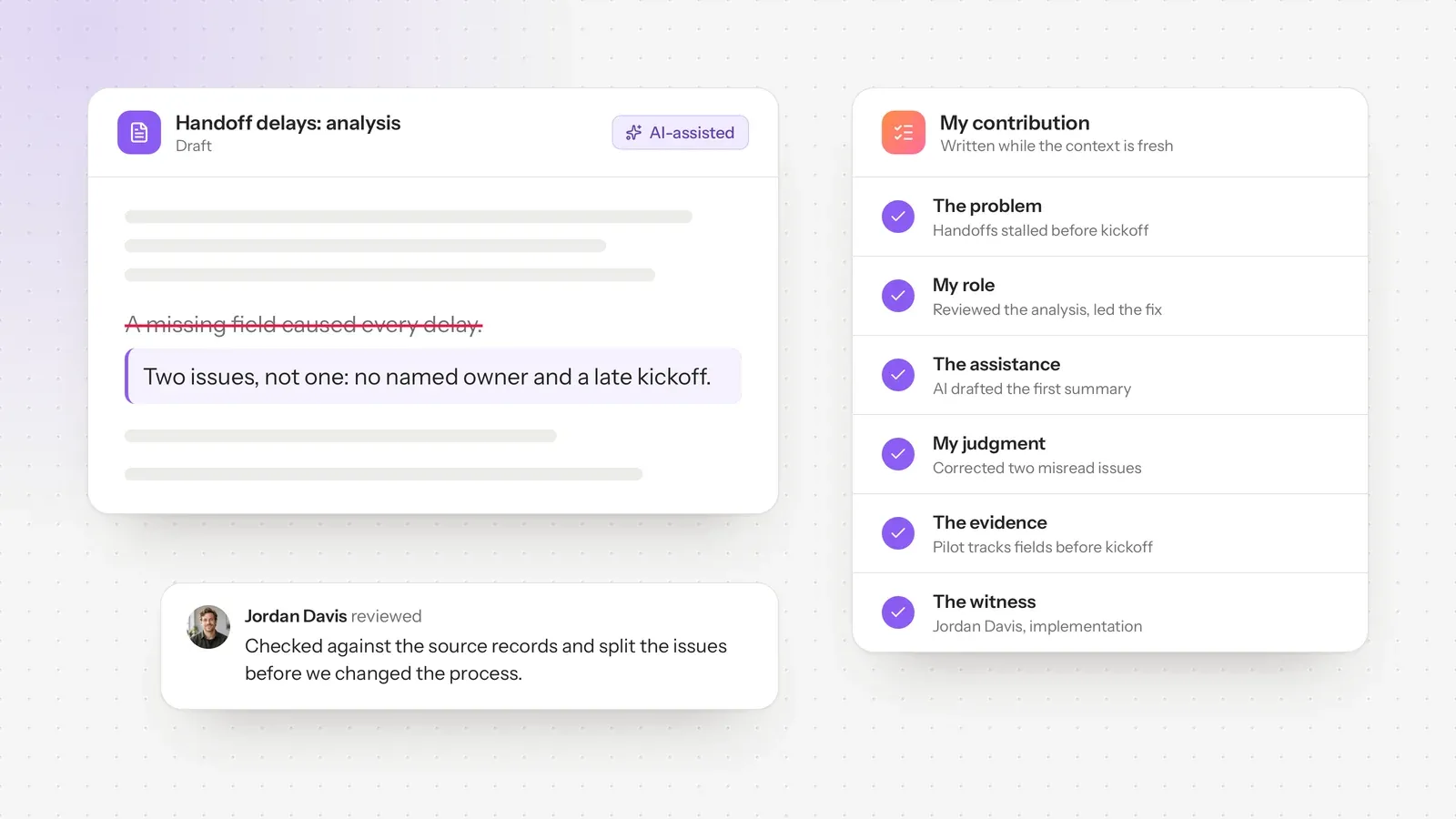
- The problem: What needed to change, and for whom?
- Your role: What did you personally own, and who else contributed?
- The assistance: Where did AI or another tool help, and where did you do the work yourself?
- The judgment: Which assumptions did you test, decisions did you make, or suggestions did you reject?
- The evidence: What result can you support, over what period, and with what limitations?
- The witness: Who can confirm the relevant work or provide context?
You do not need to paste prompts, private conversations, or customer data into a portfolio. A concise account of the process is usually more useful to a reader than a large archive they cannot evaluate. Retain sensitive evidence only in an approved internal location.
Show the check, not just the speed
Consider an illustrative sales operations example. A team uses AI to draft a summary of recurring handoff problems. The first draft merges two different issues and implies that a missing field caused every delay. A teammate notices the mismatch, checks the underlying records, and separates the issues before the team changes the process.
Weak account: “Used AI to transform sales operations and eliminate handoff delays.”
More credible account: “Reviewed an AI-assisted analysis of recent handoffs, corrected two misclassified issues, and worked with sales and implementation to revise the checklist. In the following pilot, we tracked whether the revised fields were completed before kickoff.”
The second account is less dramatic and more informative. It identifies human review, names collaboration, and distinguishes a completed action from a result that is still being evaluated. It does not claim that the tool or the employee solved a problem before the evidence exists.
Be precise about the result you actually measured
If you describe time saved, state what you compared. Was it one draft, a repeated task, or a team average? Did you include the time needed to review and correct the output? Was the quality comparable?
If you describe a revenue or retention result, avoid assigning it to one new workflow just because the dates overlap. Pricing, staffing, seasonality, and other changes may matter. You can still say what you contributed without claiming sole causation.
Sometimes the useful result is a decision not to proceed. A person may discover that an AI suggestion is unsupported or that a proposed shortcut would expose confidential data. Describe the issue they identified and the action they took. Do not invent a dollar value for a risk that never materialized.
A provisional result should remain provisional. Update the story when the evidence changes rather than keeping the more flattering early estimate.
Recognize responsibility and collaboration
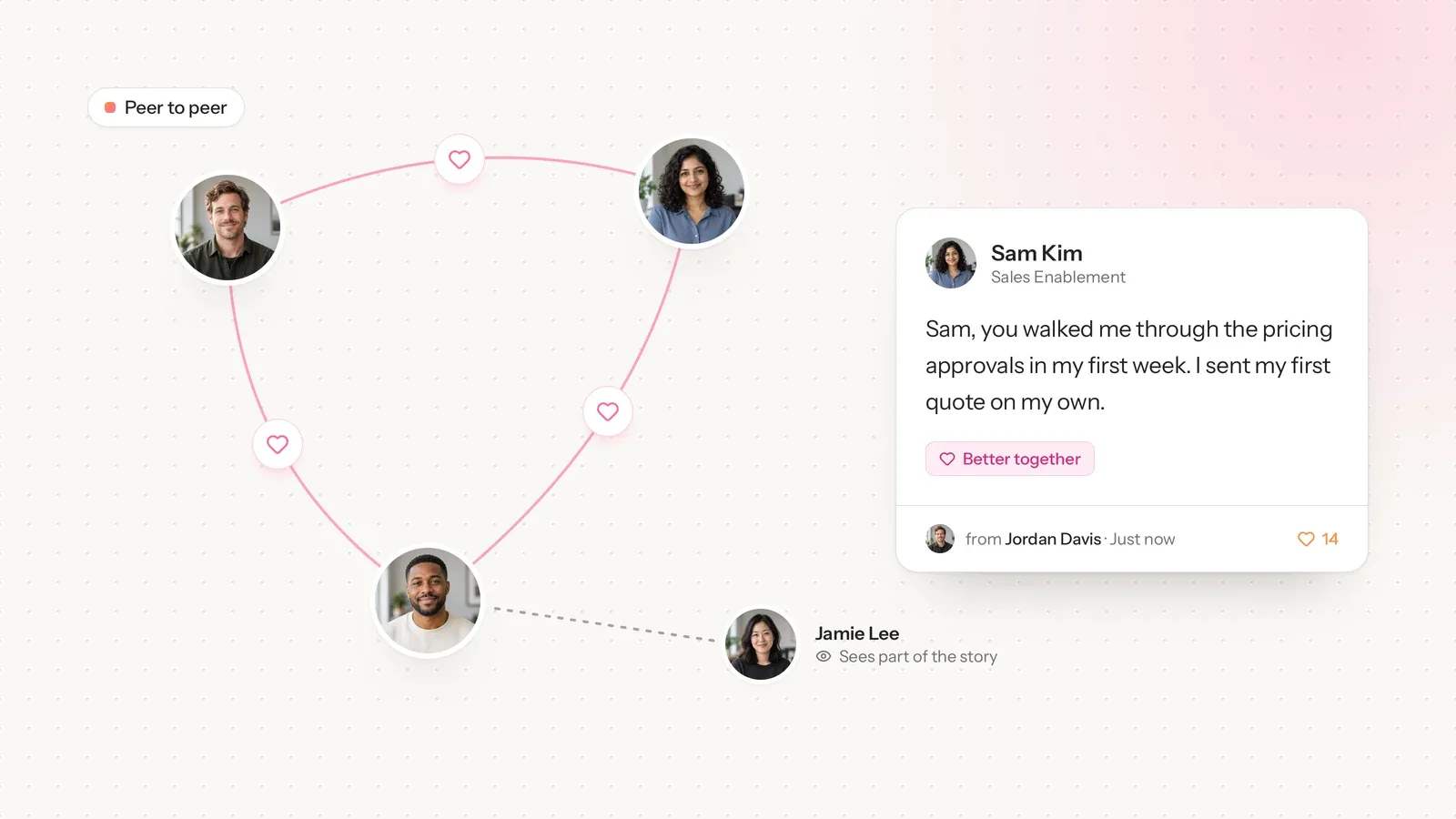
For managers, this changes what is worth noticing. Acknowledge the person who established a useful test, spotted a limitation, or made a process understandable to the next teammate. Praise should explain the contribution, not simply applaud tool adoption.
An illustrative internal message:
“Taylor, you checked the generated account summary against the source notes, caught the unsupported conclusion, and explained the correction to the team. Thank you for protecting the quality of the decision and making the review steps reusable.”
Also credit the people who supplied context, reviewed the work, and carried out the change. AI-assisted work can still depend on substantial human collaboration. A record that names those dependencies is more believable than a solo success story assembled after the fact.
Do not make employees document every interaction with a tool to earn appreciation. Focus on meaningful contributions and the evidence relevant to the claim. A career record should help someone explain their work, not become a surveillance log.
Turn the account into career evidence carefully
Keep the private working notes separate from the version intended for a professional audience. The internal version may reference approved source records. The public version should explain your role and result without exposing customer names, logos, confidential metrics, or details that identify a customer indirectly, unless you have permission from the relevant customer or company.
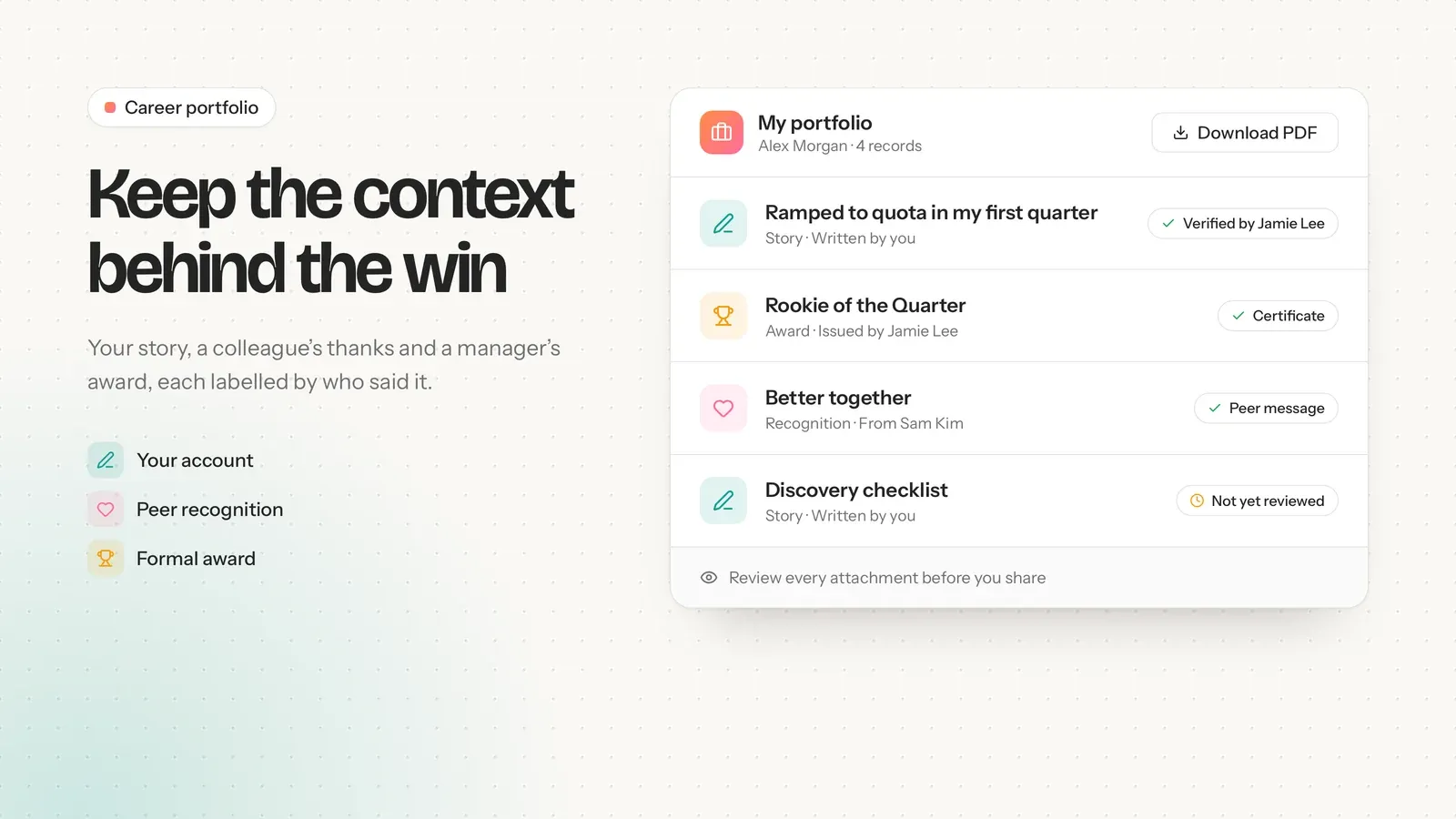
In Valori, a portfolio story can bring together your account and selected earned recognition or awards. A manager's verification is a separate status; it should not be inferred from a polished design or an attached peer message. Manager- or administrator-issued award certificates are also distinct from everyday recognition.
Review the full story and attachments before downloading or publishing. If you change the claim, seek any needed review of the changed version rather than relying on approval of an earlier account.
The strongest evidence of your contribution may be a sentence about a judgment call: what you noticed, what you changed, and why. Let the artifact support that account. It should not have to do all the explaining on its own.
Sources
- 1Agents, human agency, and the opportunity for every organizationMicrosoft Work Trend Index, 2026