Start with something you can honestly explain
You earned an award or finished a piece of work you are proud of. Now you want to share it without producing another grand announcement that could belong to anyone. Start with the part you would tell a colleague: what happened, what you contributed, and why it mattered to you.
This approach also fits the direction LinkedIn has described publicly. On September 15, 2026, LinkedIn said it was continuing to reduce generic, recycled AI content in the feed while adding writing support intended to preserve members' own voice. That is not a ban on all AI assistance or a promise that a particular post will reach more people. Read LinkedIn's announcement.
Use a writing tool to clarify your draft if it helps. Keep responsibility for the facts, the tone, and the decision to publish. A post that sounds like you and makes a modest, supportable claim is a better professional record than an inflated story optimized for applause.
Know what kind of achievement you are sharing
A peer thank-you, a formal award, and a portfolio story are different forms of evidence. Describe the one you actually have.
If a colleague recognized a helpful contribution, say that. If a manager or administrator issued an award, use the award's real title and context. If you wrote a portfolio account of a project, do not present the existence of the card as independent verification of every claim.
In Valori, recognition does not automatically become an award certificate. Formal awards are issued separately, and portfolio records can carry their own recorded verification status. Keep those distinctions in the caption and artwork. Do not add “certified,” “official,” or “verified” simply because the design looks professional.
If an award recognizes a team contribution, explain your part. An honest acknowledgment of collaboration adds context; it does not diminish the achievement.
Review the whole package for customer information
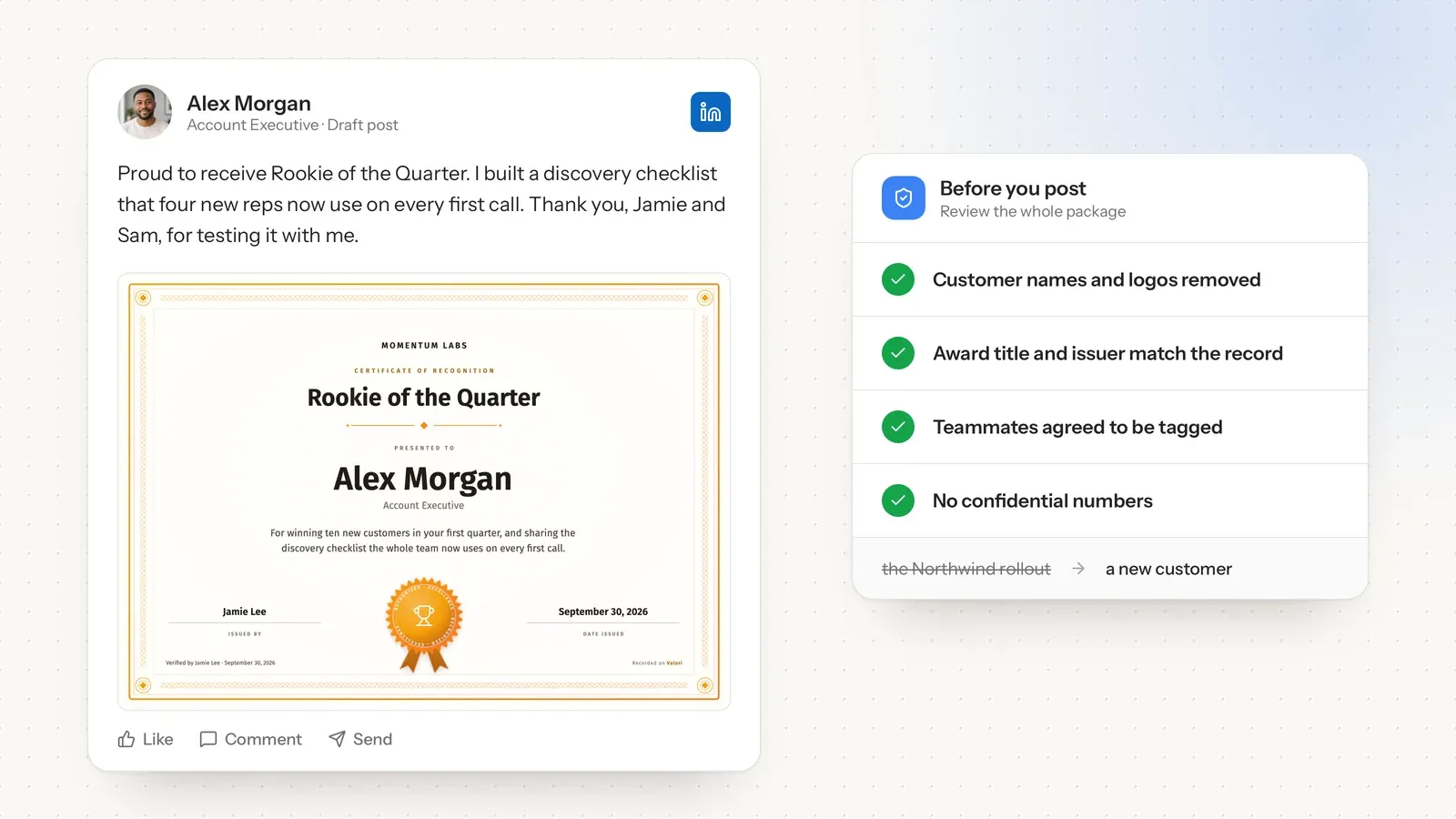
Before downloading or publishing, inspect more than the caption. Read the entire certificate or portfolio story, every attached recognition message, the image, and any linked public record. A careful caption will not protect a customer name that is still visible in the artwork.
Check for names, logos, account details, screenshots, contact information, and combinations of details that make an organization identifiable. A description such as “the only regional operator launching in this city next week” can reveal more than a generic industry label.
Remove customer-identifying information unless you have permission from the actual customer or company concerned. Your own enthusiasm, a teammate's approval, or possession of a logo is not that permission. Also check your employer's rules for confidential business information and public use of its branding.
Internal recognition and an authorized Slack discussion can contain context that does not belong on LinkedIn. Keep a useful internal account, then prepare a separate public account rather than assuming the original message is ready to share.
Write a short story with a specific center
A useful structure is: the achievement, the contribution behind it, and the people or lesson you want to acknowledge. You do not need a dramatic opening or a motivational conclusion.
Here is an illustrative draft to adapt only if it matches your actual experience:
“I'm proud to receive our team's Collaboration Award this quarter. I worked with sales and implementation to make project handoffs clearer, including a shared checklist and named owners for open questions. Thank you to the teammates who tested the process and challenged the first draft—the work is better because of you.”
This version names work a reader can understand without identifying a customer. If you include a metric, confirm the value, period, baseline, and whether it is approved for public use. An outcome does not become safe to disclose just because it is expressed as a percentage.
Credit collaborators with their permission, especially before tagging them. Remove any phrase you would feel uncomfortable explaining in a real conversation.
Let the visual support the claim
Choose a legible certificate or portfolio image with one clear purpose. A reader should be able to distinguish the award title, recipient, issuer, and relevant date without interpreting a collage of screenshots.
Check the exported file itself. Text may be longer than you remember; an attached message may contain a detail missing from the preview you first saw. Make sure the image and caption describe the same achievement and the same status.
If the original certificate includes branding you are not authorized to publish, do not casually edit it into a different-looking credential. Consider sharing a text account of the achievement or asking the issuer for a suitable public version. Keep your private copy of the original record.
For portfolio stories, edit or remove unsuitable attachments before saving and reviewing the version you intend to share. Do not rely on a cropped screenshot to hide information that remains accessible through its public link.
Publish deliberately, and keep control where you can
In Valori, review the selected saved portfolio record before creating a public share. Preview the published content and copy the intended link only when you are ready. Downloading an image or PDF and publishing a link are different actions; neither should be mistaken for automatically posting to LinkedIn.
A public link can be revoked, but revocation cannot retrieve screenshots, downloaded files, or copies someone has already made. Choose the audience and content with that limitation in mind. You can celebrate a meaningful achievement without publishing all the evidence behind it.
Avoid engagement tricks. LinkedIn's March 12, 2026 feed update described efforts against repetitive, low-substance content, engagement bait, automated comments, and engagement pods. There is no need to add “comment to agree” to a professional milestone. Read the feed update.
After publishing, respond in your own voice and correct any factual error promptly. A career post should leave a reader with a clear picture of your work and judgment. Reach is uncertain; accuracy, permission, and appropriate credit are decisions you can make before pressing publish.
Sources
- 1How LinkedIn is Continuing to Tackle AI SlopLinkedIn, 2026
- 2