Notice work across locations
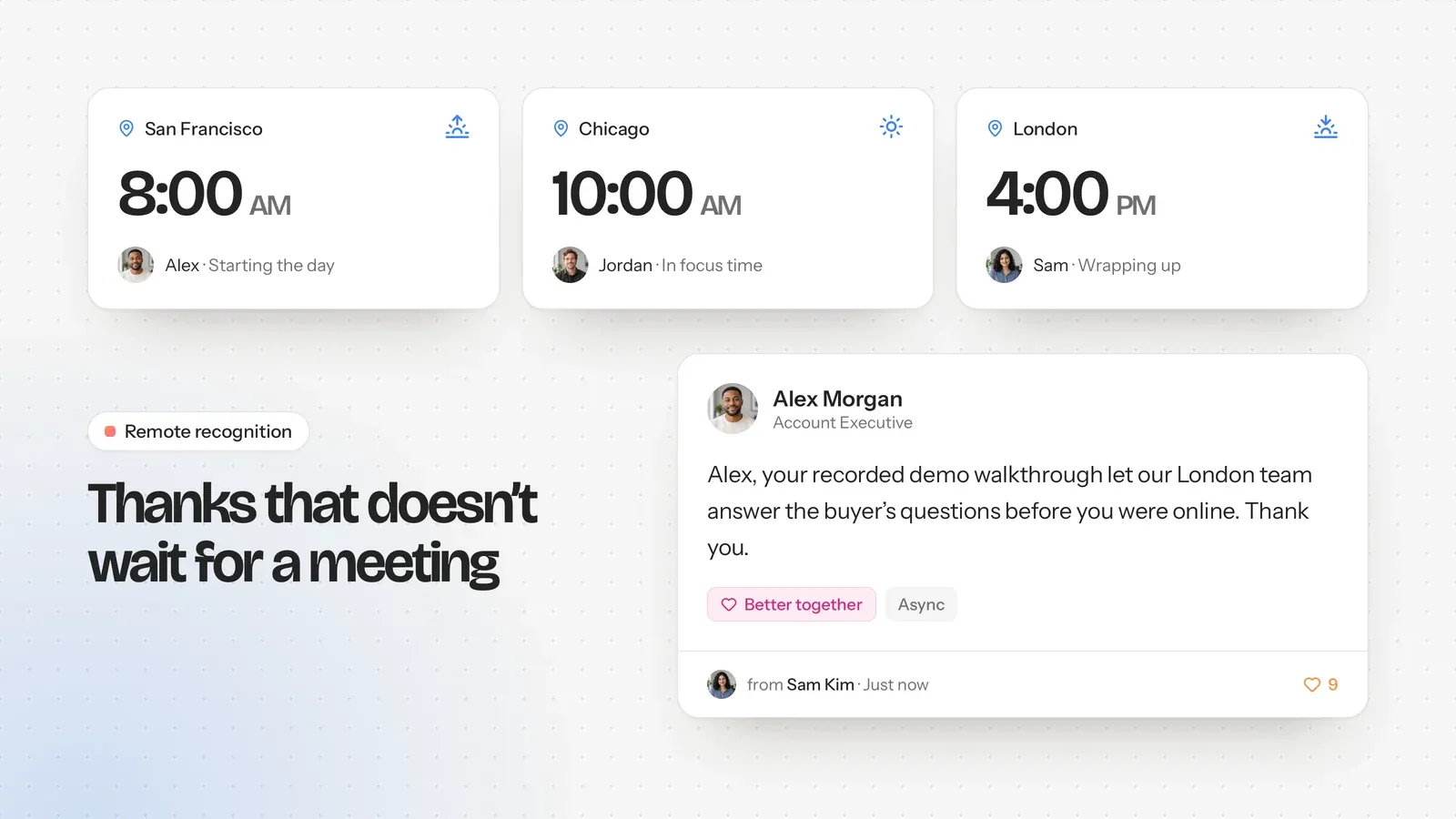
Remote and hybrid work can make some contributions less visible to a manager. That is a reason to ask for context deliberately, not to assume people in one location work harder or deserve more praise.
Ask teammates what helped them recently, include colleagues across time zones, and acknowledge the work behind a result. These ten practices are editorial suggestions to adapt to your team, not a guaranteed engagement intervention.
Best Practice 1: Make Participation Straightforward
Choose an accessible place for internal recognition and show people how to use it. Keep required fields focused on the recipient, the contribution, and why it mattered.
If your company has configured Valori's Slack integration, demonstrate the supported workflow in your own workspace. Avoid assuming that every tool has the same commands, permissions, or integration coverage.
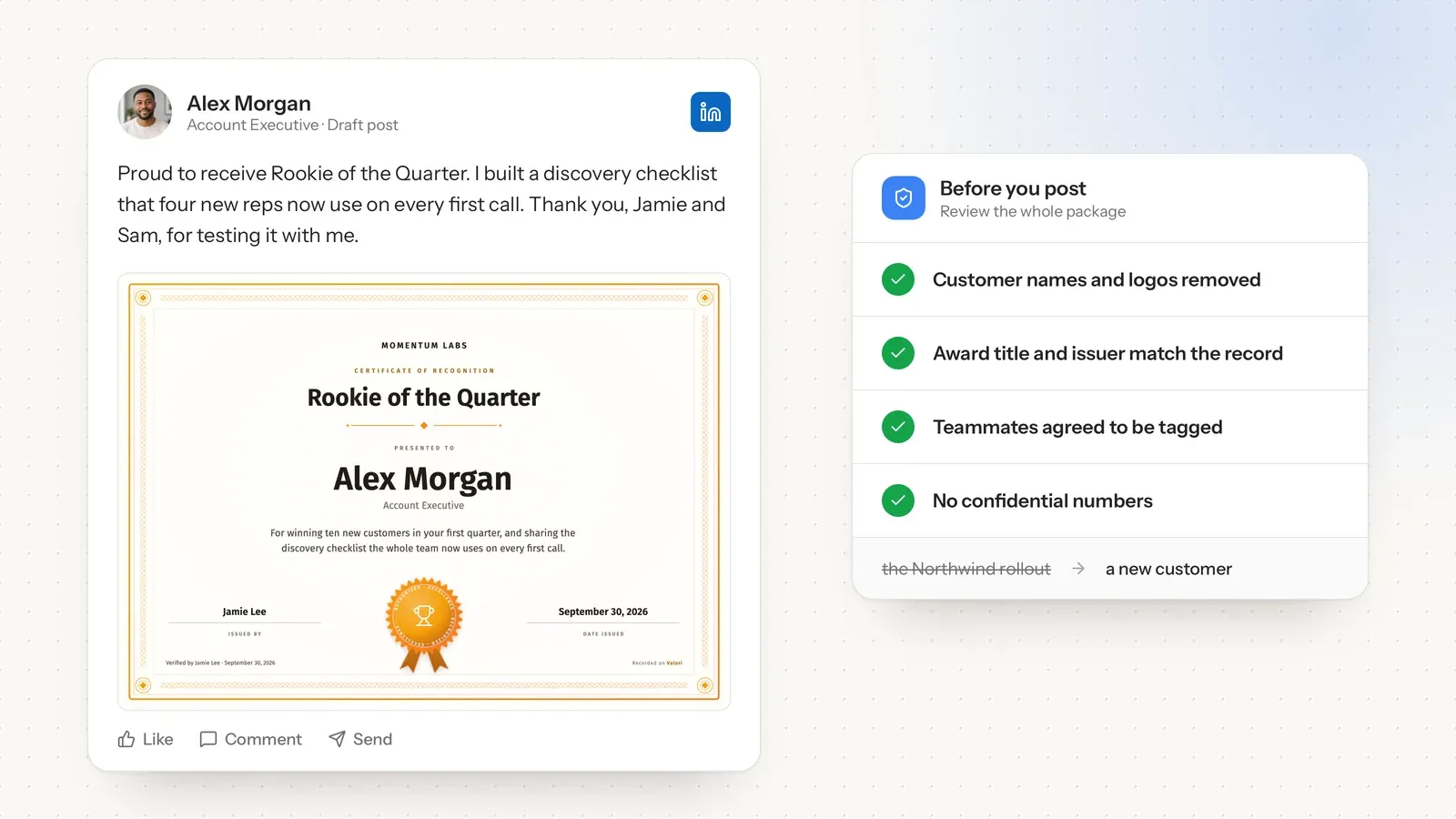
Keep customer details within their authorized audience. An internal recognition message may need a separate public version before it is used in a portfolio or on LinkedIn.
Admin Settings
Manage your workspace
164
234
12
3
app.valori.com/join/acme-corpA configured Slack integration can bring recognition into an existing team workflow
Best Practice 2: Choose the Right Audience
A team-visible message can help colleagues understand a contribution they did not see directly. A private thank-you can be more appropriate for someone who dislikes public attention or for work involving confidential information.
Ask the recipient what they prefer. Share useful context internally with the right audience, and get permission before turning a private achievement into a public story. Visibility should serve the recipient and the work, not a participation target.
Best Practice 3: Be Specific and Timely
"Great job this week!" is not recognition. It's noise.
Effective recognition is specific about:
- What the person did
- Why it mattered
- How it connects to team or company goals
Give recognition while the details are fresh. If you missed the moment, a thoughtful acknowledgment later is still worth making.
Illustrative example: "Sarah, your quick thinking on the production incident last night was incredible. You identified the database bottleneck and gave the response team a clear next step. That's exactly the kind of ownership and technical excellence that makes our team great."
Bad example: "Sarah has been doing great work lately. Keep it up!"
The first version explains a contribution. Review any sensitive context before sharing it outside the team.

Sarah Jenkins
Enterprise Account Executive
Sarah absolutely crushed the Alpha Corp deal! She navigated complex stakeholder dynamics, addressed every objection with precision, and closed 40% above our initial target. This is what strategic selling looks like! 🎯
 From Alex Rivera•2h ago
Specific, timely recognition tied to values — the foundation of remote team culture
Best Practice 4: Enable Peer-to-Peer Recognition
Here's something managers often miss: peers see things you don't.
Your direct reports are in meetings you're not in. They observe each other's work in ways you can't. They know who stayed late to help debug an issue, who always takes time to explain things to new team members, who brought snacks to the virtual coffee chat.
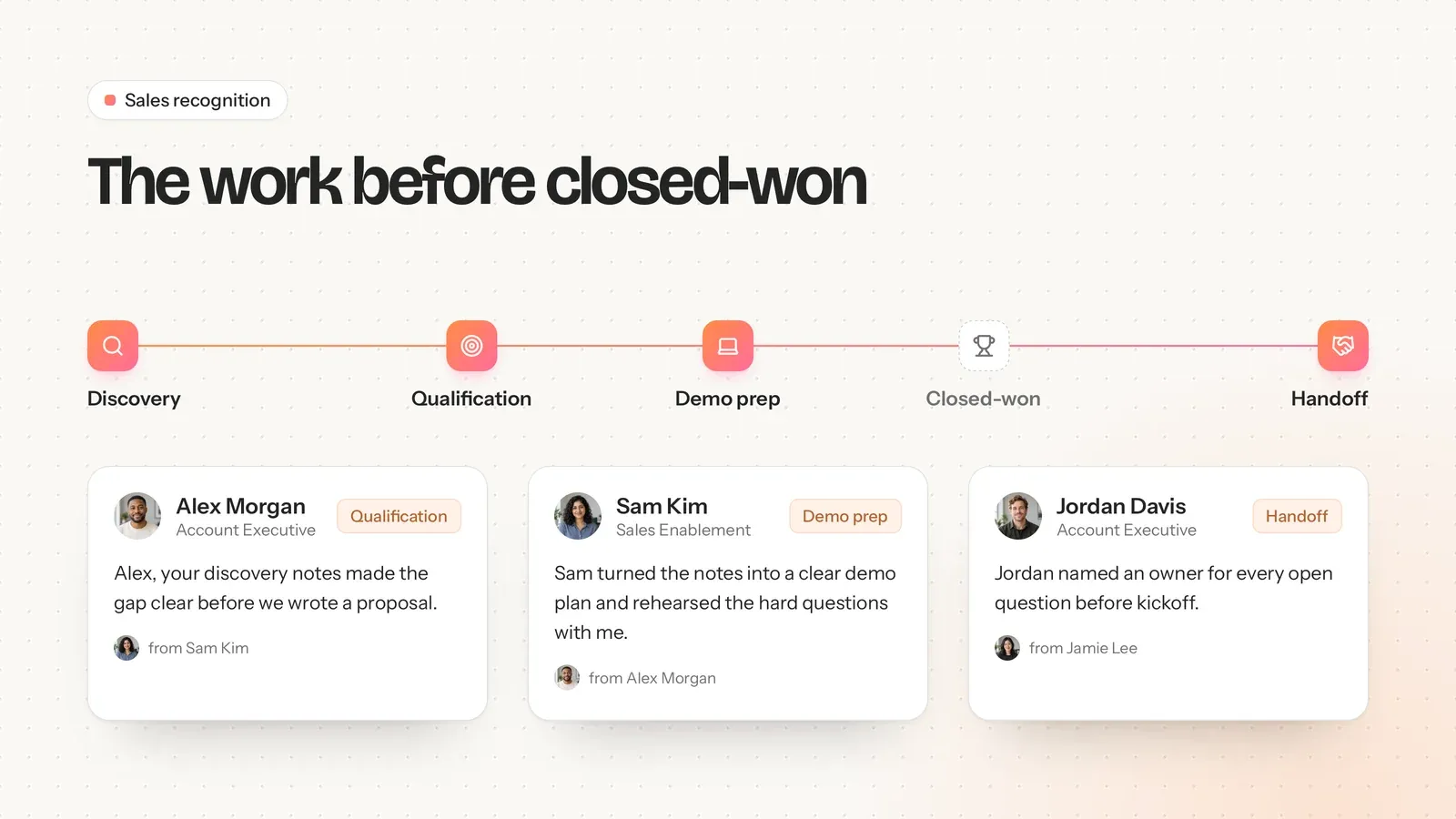
What to do: Don't gate recognition behind manager approval. Give everyone the ability to recognize anyone. Trust your team to celebrate each other. Keep everyday appreciation separate from formal award decisions and verification.
Best Practice 5: Create Recognition Rituals
Remote teams lack the natural rituals of office life — the Monday morning standup, the Friday afternoon wind-down, the spontaneous coffee run. You need to intentionally create new rituals, and recognition should be part of them.
Weekly:
- Kick off Monday team meetings with a "recognition round" where anyone can shout out a colleague
- End Friday syncs with a "wins of the week" segment
- Maintain a #kudos or #wins channel that gets consistent activity
Monthly:
- Spotlight top recognized employees in company newsletters
- Celebrate work anniversaries and milestones
- Review recognition metrics in manager meetings
Quarterly:
- Recognize quarterly MVPs tied to company values
- Share recognition highlights in all-hands meetings
- Analyze recognition patterns for team health insights
Rituals create consistency. In a remote environment where so much is asynchronous and ad-hoc, having reliable recognition moments builds culture.
Best Practice 6: Design for Async
Your team probably spans multiple time zones. Even if they don't, different people have different work hours and rhythms. Recognition needs to work asynchronously.
What this means:
- Recognition should be readable on any schedule, not just live in ephemeral chat
- Achievements should be captured in a persistent, searchable format
- People shouldn't miss recognition moments because they were offline
- Global teams should be able to participate equally regardless of time zone
What to do:
- Use a recognition platform with a persistent feed (not just chat)
- Send recap digests so people catch up on recognition they missed
- Record recognition highlights for async-first all-hands meetings
- Avoid real-time-only recognition events that exclude some time zones
Best Practice 7: Connect Recognition to Values
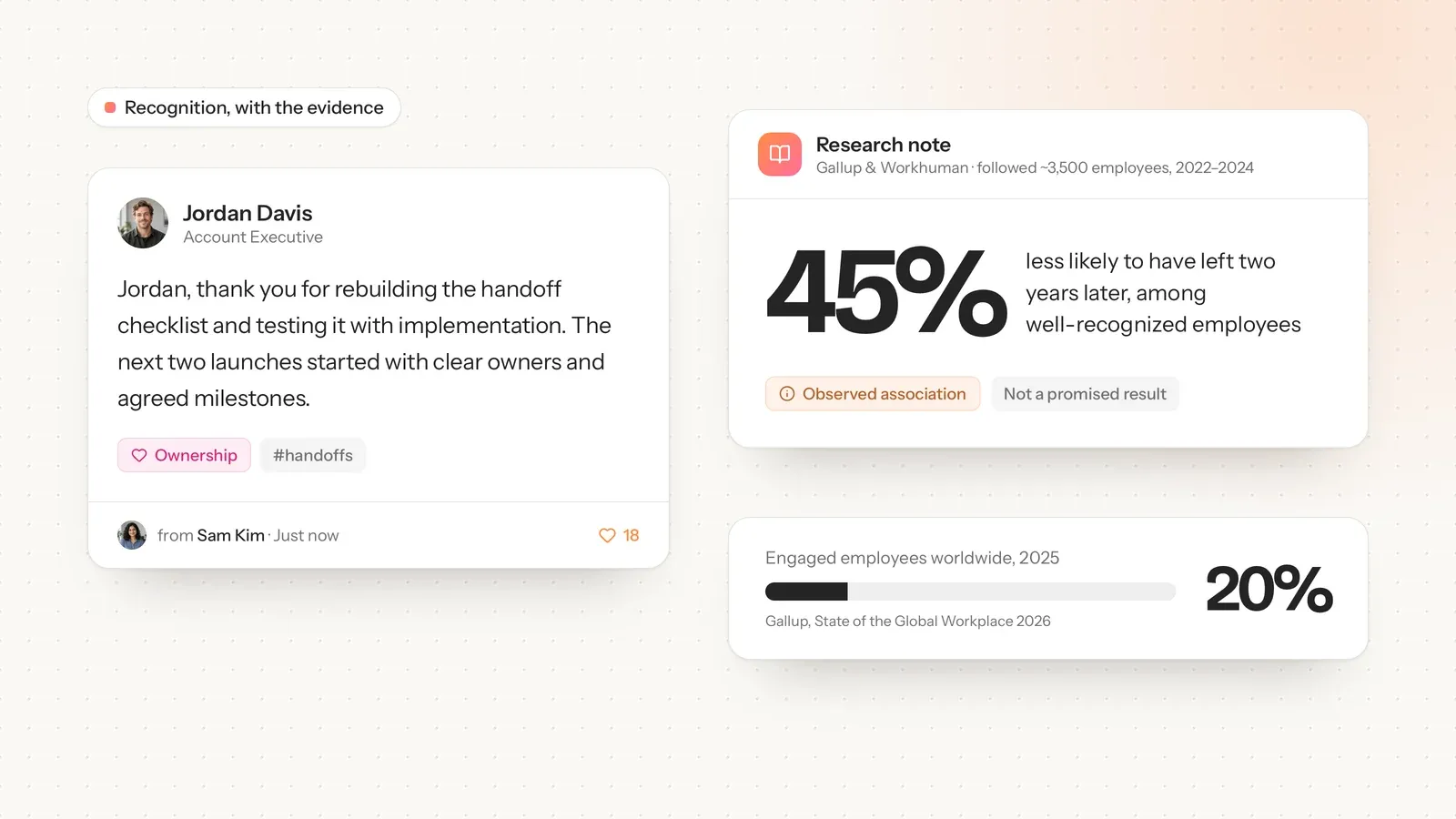
Generic recognition feels hollow. When recognition is tied to specific company values — "Maya demonstrated ownership by clarifying the implementation handoff" — it does three things:
- Reinforces what matters: Values are only real if they're connected to behavior. Recognition is how you make that connection explicit.
- Provides specificity: Values give you a vocabulary for explaining why something mattered, not just what someone did.
- Enables tracking: When recognition is tagged by value, you can measure which values are being lived and which are neglected.
What to do: Build value tagging into your recognition system. When someone sends recognition, they select which company value it demonstrates. Over time, you'll have rich data about which values are active in your culture.
Best Practice 8: Track and Analyze
What gets measured gets managed. Recognition is no exception.
Metrics to track:
- Frequency: Recognitions per employee per month
- Participation: % of employees giving and receiving recognition
- Distribution: Are all teams/departments being recognized equitably?
- Manager participation: Are leaders modeling recognition behavior?
- Cross-team recognition: Is recognition flowing across organizational boundaries?
- Value alignment: Which values are being reinforced most/least?
Why it matters: Data surfaces blind spots. Maybe your engineering team is great at recognizing each other, but your sales team is a recognition desert. Maybe everyone's recognizing "teamwork" but nobody's recognizing "innovation." Maybe some managers are recognition champions while others haven't sent a single one.
Treat these patterns as prompts for a conversation. Recognition counts reflect visibility and participation; they are not a ranking of employee performance.
Best Practice 9: Make It Personal
Different people prefer different types of recognition. Some love public praise and thrive on visible acknowledgment. Others find public recognition embarrassing and prefer a private thank-you.
What to do:
- Learn individual preferences (some platforms let employees set their own)
- Offer options: public recognition, private recognition, or both
- Vary the format: written recognition, video shout-outs, awards, certificates
- Remember personal context: birthdays, work anniversaries, milestones
One-size-fits-all recognition is lazy recognition. Take the time to understand how each person prefers to be appreciated.
Best Practice 10: Lead by Example
Leaders can demonstrate the specificity and care they want to see. Recognize a contribution you actually observed, credit collaborators, and explain why it mattered.
Give managers time and useful examples rather than a quota of messages to send. Ask what makes acknowledgment difficult and address the obstacle. If repeated praise centers on overtime or emergencies, examine the workload or process that created them.
Keep the practices that help your team notice good work. Change the ones that feel forced. A sustainable habit should make appreciation easier without turning it into another performance of busyness.