Use the report year and the observation year
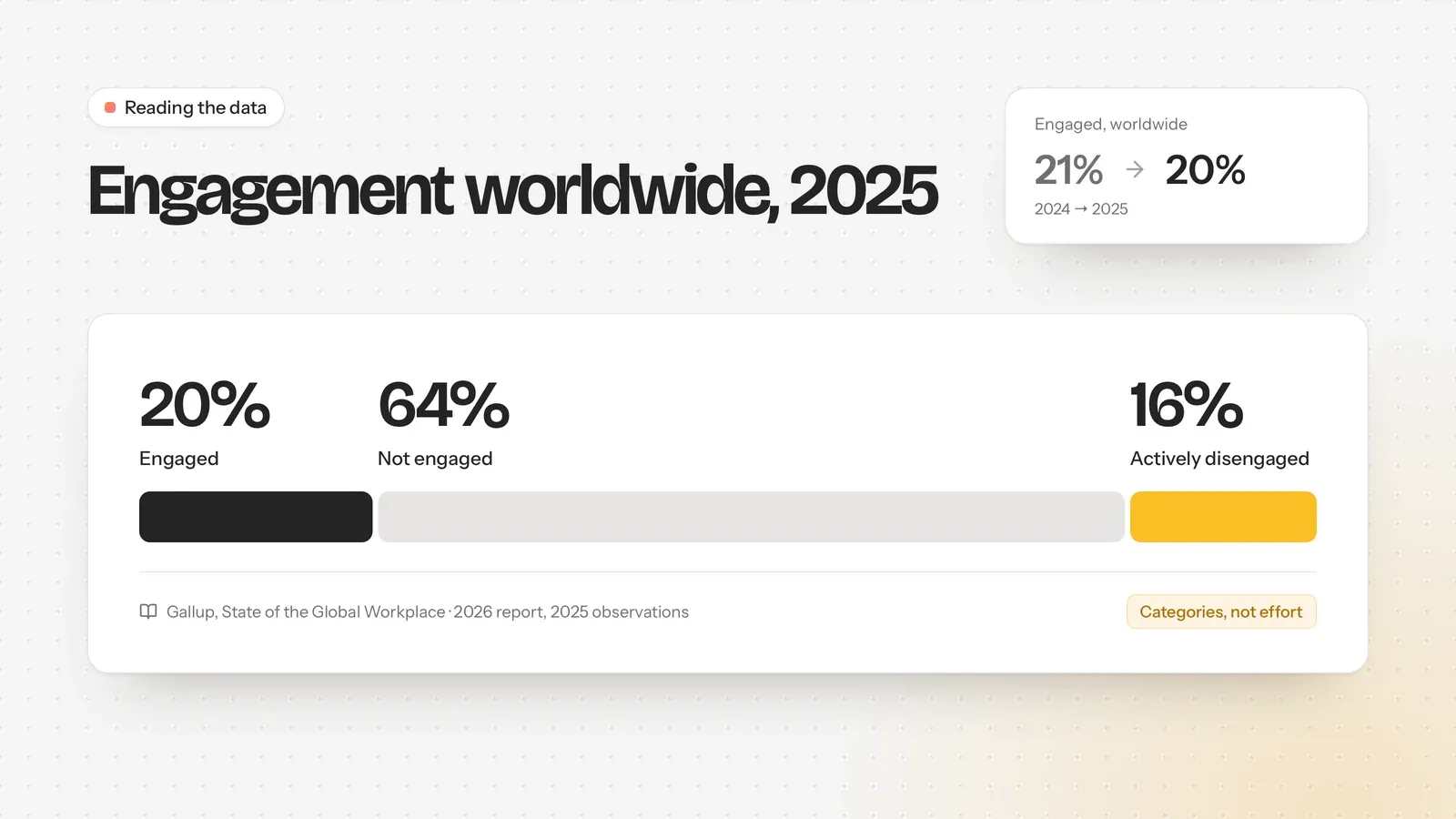
Gallup's 2026 State of the Global Workplace reports global employee engagement of 20% for 2025, compared with 21% in 2024. The report's publication year and the year of the underlying observations are different. Read the 2026 report.
Keep both dates attached when quoting the figure. Do not relabel an older estimate as a new survey simply because a blog post has been updated. Also avoid combining a productivity-cost estimate from one report with an engagement percentage from another as though they describe the same period.
Read the categories carefully
Gallup's global data classifies 20% of employees as engaged, 64% as not engaged, and 16% as actively disengaged in 2025. These are engagement categories, not direct measures of effort, competence, or how much work an individual completed. See the global data and definitions.
It would be misleading to describe everyone outside the engaged group as lazy or unproductive. Use the figures to ask questions about the work experience, not to label employees you have not listened to.
Global results also cannot tell you the engagement level of your own company. Your team's location, roles, leadership, and circumstances may differ from the aggregate.
Recognition evidence answers a different question
An engagement survey, a recognition count, and a retention measure describe different things. One cannot automatically stand in for another.
Gallup and Workhuman's recognition study followed employees over two years and found an association between quality recognition and retention. That supports taking recognition seriously; it does not establish a guaranteed return for a particular product or program. Read the recognition study summary.
When presenting evidence to a team, label what was measured, who was included, and whether the finding is an association or a tested causal effect. Leave out a statistic if you cannot locate the actual source supporting it.
Turn the context into useful local questions
Ask whether people know what is expected of them, have support to do the work, and receive acknowledgment that describes their contribution accurately. Give managers room to explain the pressures they face too.
Review recognition participation and distribution as clues to visibility. A low count may indicate missing acknowledgment, a private communication preference, or work that is difficult for others to observe. Investigate before drawing a conclusion.
Keep the underlying problems in view. Recognition cannot replace fair pay, manageable workloads, effective tools, or a credible development conversation. If feedback identifies one of those issues, a new appreciation ritual is not a complete response.
Use external research to frame better questions and your own evidence to assess what changed. Report the limitations alongside the result rather than making a confident claim the data cannot support.
Sources
- 1State of the Global Workplace: 2026 ReportGallup, 2026
- 2State of the Global Workplace: Global DataGallup, 2026
- 3