Use a scenario, not a promised return
A recognition proposal should explain the problem it aims to address and what it will cost to try. It should not begin by promising that a tool will reduce turnover by a fixed percentage or produce a universal return.
Recognition research can motivate an investment without supplying your company's forecast. Gallup's longitudinal recognition research reports an association with employee retention; it does not establish a guaranteed program effect for another workforce. Read the study summary.
Start with a specific aim, such as helping managers acknowledge useful work across a distributed team. Then decide which observations would make you continue, change, or stop the pilot.
Count the complete cost
Include software, setup, administration, manager time, and any funded rewards. Use your actual expected headcount and billing terms. Distinguish one-time implementation work from recurring expense.
Keep reward budgets separate from recognition activity so reviewers can see what each part costs. Include the operational effort needed to manage awards fairly and answer employee questions. A low subscription price does not make the rest of the program free.
For a pilot, record the cost you can observe during the pilot rather than extrapolating every line into a precise annual total. Label annual estimates and show the assumptions behind them.
An illustrative break-even calculation
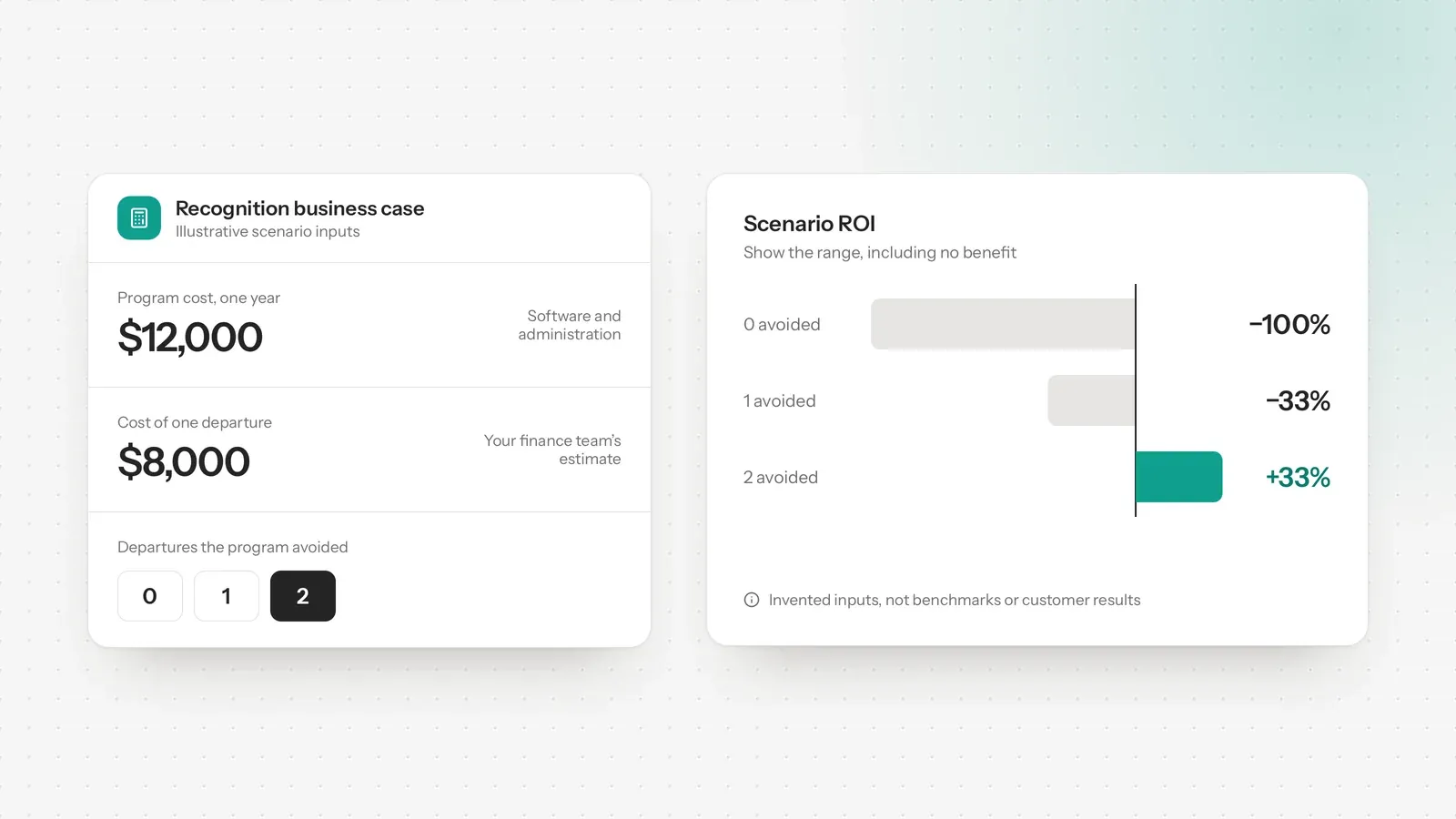
Suppose a program costs $12,000 for a year, including software and administration. Suppose your finance team estimates the avoidable cost of one departure at $8,000. These are invented scenario inputs, not industry benchmarks or Valori customer results.
On those assumptions, avoiding two departures would represent $16,000 in gross savings. Subtracting the $12,000 cost leaves $4,000; dividing by the cost gives a scenario ROI of about 33%. With no attributable avoided departures, the same calculation gives a negative 100% return on this financial measure.
The difficult part is not the arithmetic. It is establishing whether the program caused any departures to be avoided. Do not label the favorable scenario a realized saving simply because total turnover fell.
Show a range of assumptions, including no benefit, and state which cost estimates are cash savings versus recovered capacity. Time freed up is not automatically money removed from the budget.
Measure without counting the same benefit twice
Record a baseline before the pilot: participation, employee feedback, and relevant team conditions. If you track turnover, keep the definition and population consistent over time. Document changes in pay, leadership, hiring, workload, or market conditions that could also affect results.
Where practical, compare similar groups or use a phased rollout, while acknowledging that teams may differ in ways the comparison does not capture. Ask employees whether recognition felt accurate and useful; a financial model alone will miss that experience.
Avoid adding retention savings, replacement productivity, and recovered ramp time as three separate benefits if your replacement-cost estimate already includes them. Use conservative, clearly separated categories.
Finish the business case with what you know, what remains uncertain, and the next decision. A transparent pilot with a modest learning goal is easier to evaluate than a dramatic ROI percentage assembled from unrelated studies.
Sources
- 1