A warning signal, not a verdict on your people
A quiet team is easy to misread. Perhaps people are concentrating. Perhaps they are exhausted. Perhaps useful work is happening in conversations their manager never sees. A lack of enthusiastic messages does not tell you which explanation is correct.
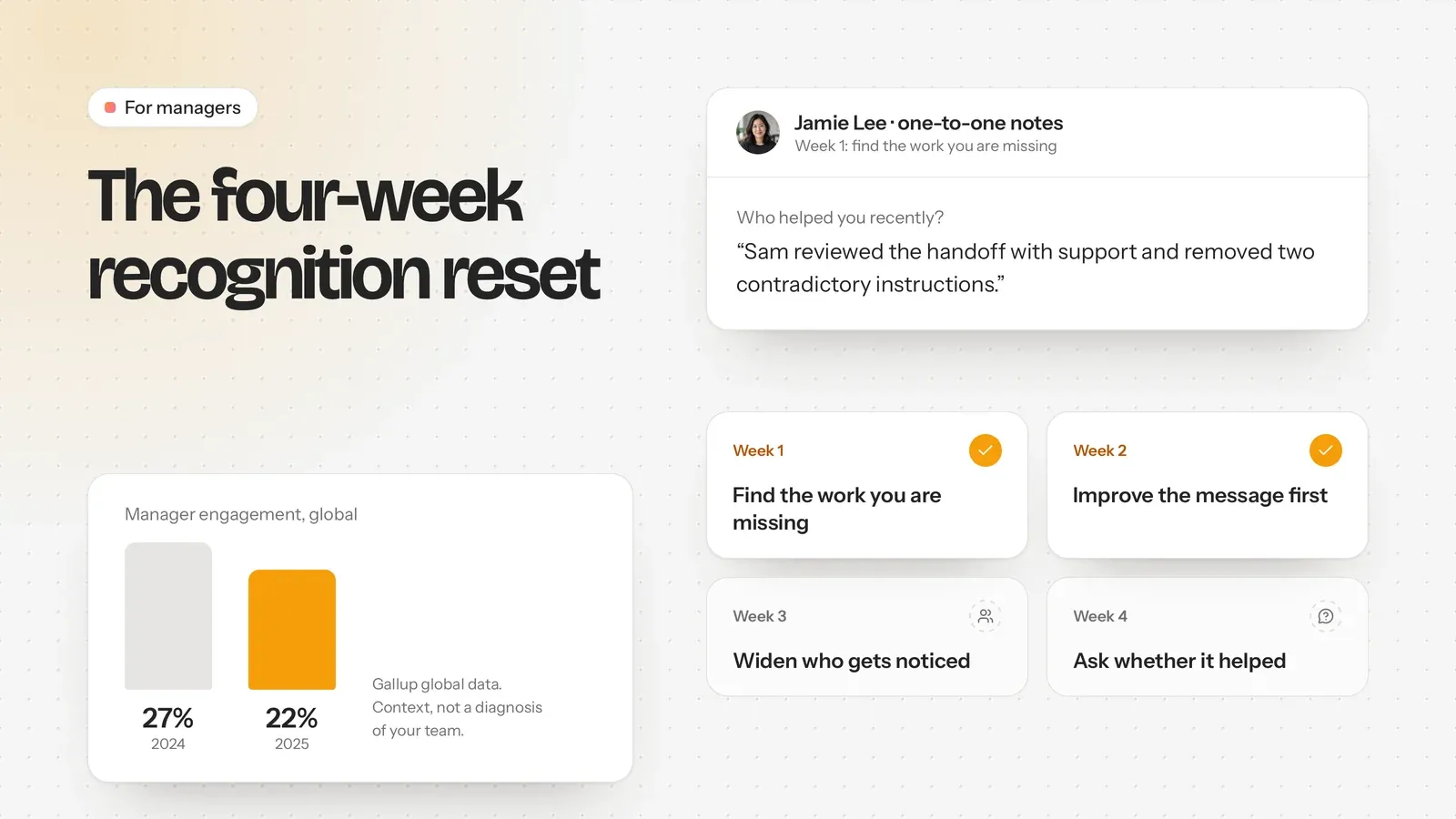
Gallup's 2026 global data offers relevant context: manager engagement fell from 27% in 2024 to 22% in 2025. Overall employee engagement was 20% in 2025. These are global estimates, not a diagnosis of your workforce or proof that recognition alone can change the result. Explore Gallup's global data.
For a team leader, the useful response is to inspect the daily experience. Do people understand the priorities? Can they get help? Does anyone notice when they make a difficult piece of work go well? And does the manager have enough capacity to answer those questions?
Recognition belongs in that conversation. Adding a compulsory weekly post to an already overloaded manager's checklist does not. The four-week reset below is an editorial framework for making acknowledgment more thoughtful and manageable. It is a starting point to adapt, not a research-validated intervention.
Week one: find the work you are missing
Begin with observation. In existing one-to-ones, ask each person about a contribution they were proud of and a colleague who helped them recently. Let people answer later in writing if that suits them. Do not demand a polished success story.
Look beyond the visible finish line. Who clarified a confusing requirement? Who noticed a risk early? Who helped a new starter work independently? Who closed a loop that would otherwise have become someone else's emergency?
Keep brief, factual notes. A useful note has a date, the action, and the effect you can actually support. “Reviewed the handoff with support; removed two contradictory instructions” is better than “always goes above and beyond.”
Also ask how each person likes to be thanked. Some welcome an internal team post; others prefer a direct conversation. Recognition should help the recipient feel seen, not put them on a stage they did not choose.
Week two: improve the message before increasing the volume
Take a vague message and rewrite it with three details: what happened, what the person contributed, and why that mattered.
An illustrative example:
“Priya, you noticed that our renewal handoff had no clear owner and brought sales and support together to fix it. We now have an agreed next step for every account in this week's review. Thank you for making the transition clearer for everyone involved.”
That is stronger than “Amazing teamwork!” because another reader can understand the contribution. It also avoids a claim such as “saved the quarter,” which the writer may not be able to substantiate.
Do not turn every message into a performance assessment. A straightforward thank-you for a helpful act is enough. Reserve formal awards for deliberate decisions with clear criteria, and avoid implying that a peer's message is managerial approval.
If writing feels hard, ask the giver to say it out loud first. Edit for clarity, keep their voice, and check the facts with them before sending.
Week three: widen who gets noticed
Review the examples collected so far. Are they all from the same project, time zone, or confident speaker? Has recognition concentrated on the person presenting the work while missing the people who prepared it?
Use those patterns to ask better questions. Invite implementation, operations, and support colleagues to describe helpful contributions they have seen. Credit the specific people involved rather than adding a broad “thanks to everyone” after naming one star.
This is not an instruction to distribute identical praise. People have different work and different opportunities to be visible. The point is to check your field of view before assuming that a lack of messages means a lack of contribution.
Keep a route for private feedback too. Someone may be doing valuable work that involves sensitive customer issues or confidential planning. A private acknowledgment can be entirely appropriate; public visibility is not the measure of its value.
Week four: ask whether it helped
Bring the team back to the original purpose. Ask a few short questions: Did the acknowledgment describe work accurately? Did it feel appropriate? Are important contributions still being missed? What made it awkward or difficult to participate?
Pair those answers with simple operational observations. How many different people gave and received recognition? Were messages specific? Did participation depend on repeated reminders? Do not convert those observations into a ranking of employee worth.
A manager also needs to report what the reset revealed about the work itself. If people keep rescuing the same broken process, fix the process. If the same person repeatedly works late, discuss workload and coverage. Thanking someone for absorbing a problem should not become permission to leave the problem in place.
Recognition and practical support should reinforce each other. When someone raises an obstacle, a visible follow-through can matter more than a polished appreciation message.
Keep the practice small enough to sustain
After the reset, retain the useful habits: a question in one-to-ones, a short place for peer acknowledgment, and a periodic check for overlooked work. Drop steps that exist only to fill a dashboard. Managers should have room to pay attention rather than produce a stream of ceremonial posts.
In Valori, everyday recognition can capture a specific contribution; managers and administrators can separately issue formal awards. A person can select relevant earned evidence for a portfolio story when they have a reason to tell that story. Those are different decisions, and none needs to happen automatically after a thank-you.
Internal recognition and external sharing also require different judgment. Before publishing a portfolio record or downloading material for public use, review the full message and attachments. Remove customer names, logos, and identifying details unless the relevant customer or company has given permission.
A successful first month may simply reveal work you were missing and make two conversations easier. That is a concrete result you can examine. Build from it without promising that a recognition tool will solve every reason people feel disconnected.
Sources
- 1State of the Global Workplace: Global DataGallup, 2026